Am I Healing, or Am I Just Avoiding Life? — The Question That Haunts Trauma Recovery
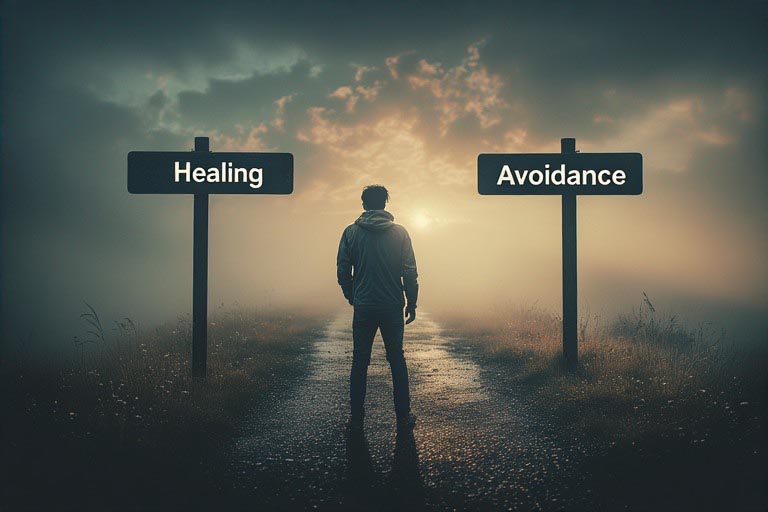
At some point in serious trauma recovery, almost everyone arrives at a version of the same terrifying question:
Am I actually healing — or am I just hiding?
It arrives in the quiet moments. After canceling plans because the fatigue hit without warning. After another disrupted night of sleep and vivid dreams. After declining something that other people do without thinking — a night out, a new class, a job application — because your nervous system gave a clear signal that it wasn’t ready.
The question comes with a voice attached. A harsh one. It says: you’re weak. You’re avoiding. Other people cope. You’re using “healing” as an excuse to not live your life.
That voice feels important. It feels like honesty. It feels like the part of you that still has some standards, some drive, some refusal to let yourself off the hook.
But I’ve come to believe that voice is not honesty. It’s a very old survival program, running on outdated instructions.

What Genuine Avoidance Actually Looks Like
It’s worth being precise about this, because the distinction matters.
Avoidance — in the clinical sense, the kind that actually keeps people stuck — looks like numbing. It looks like drinking enough that you don’t have to feel things. It looks like working eighty hours a week so there’s no space for anything uncomfortable to surface. It looks like scrolling for hours to keep the mind too busy to land anywhere. It looks like denial — the insistence that nothing is wrong, nothing needs attention, everything is fine.
What I’m describing, and what many people in trauma recovery are doing, looks completely different.
It looks like going to therapy and sitting with things that are genuinely painful. It looks like reading something about your own patterns and having to stop, because your nervous system needs time to absorb it. It looks like interrupted sleep full of intense dreams, which is what a brain in active processing mode actually does. It looks like exhaustion — the specific, bone-deep fatigue that comes not from doing nothing, but from doing extraordinarily demanding neurological work.
It looks like choosing, deliberately, not to add major stressors while the system is already stretched to its limits.
That is not avoidance. That is pacing. And pacing is not weakness — it is one of the most sophisticated and difficult things a person can do, especially when every internalized voice is screaming at them to push harder.
Why the Voice Calls You Weak Anyway
Here’s the part that took me a long time to understand.
The voice that accuses you of weakness and avoidance — that voice has a history. It wasn’t born inside you. It was installed.
For people who grew up in environments where pressure was the primary motivational tool, where rest was treated as laziness, where slowing down meant vulnerability and vulnerability meant punishment — that voice is the internalized sound of that environment. It is your parents’ regulation system, now running inside your own head.
And crucially: that system has a specific terror. It believes that if you stop pushing, you will disappear. That ease is the beginning of collapse. That the moment you give yourself permission to rest, you will never come back.
So when you are doing the most important work of your life — the slow, exhausting, non-negotiable work of integrating decades of unprocessed experience — that voice panics. Because what you’re doing looks, from the outside of its logic, exactly like stopping.
It isn’t stopping. But the voice doesn’t know the difference between rest that heals and rest that collapses. It only knows: movement equals safety, stillness equals danger.
That is trauma speaking. Not truth.
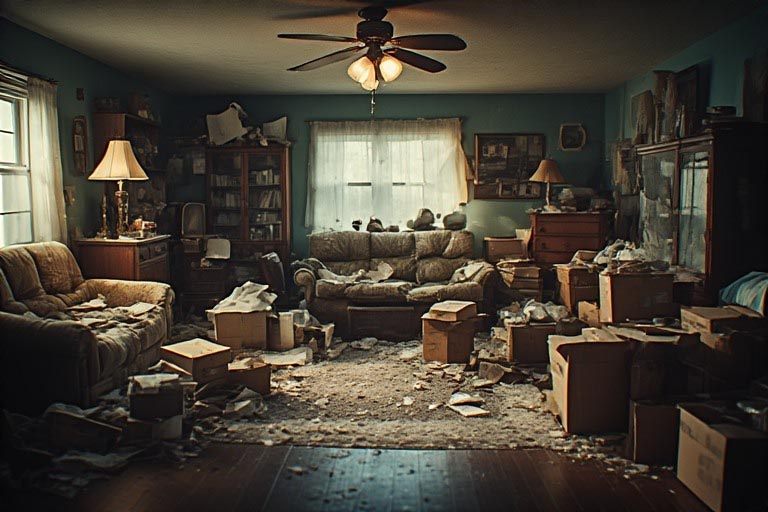
The Room Full of Old Furniture
There’s a metaphor I keep coming back to for this phase of healing.
Imagine trying to live in a room that’s been packed, floor to ceiling, with old furniture. Heavy pieces, all of them — some broken, some just outdated, all of them taking up space that should be free for actual living. The room is so full you can barely move through it.
Now imagine someone telling you that while clearing that room, you should also be furnishing a new apartment, going to parties, building a career, starting a relationship.
It’s not that you couldn’t do some of those things, technically. It’s that you’d be doing them in a cramped, cluttered space, unable to move properly, constantly knocking into things, exhausted from navigating the obstruction. And the clearing would never happen, because there’s never a moment to simply focus on it.
Some phases of life require you to clear before you can build. The clearing is the work. The clearing is the progress. The fact that it doesn’t look like conventional productivity from the outside doesn’t make it less real or less necessary.
What Trauma Recovery Actually Costs
I want to be direct about this because it is not talked about enough: deep trauma recovery is genuinely expensive. Not just financially, though that too — but in terms of energy, attention, and neurological resources.
When the brain and nervous system are doing the work of trauma integration, they are doing something that researchers sometimes compare to major neural renovation. Old threat-response circuits are being examined and updated. Identity structures that were built around survival are being reorganized. Emotional memories that were stored in the body are being processed and metabolized. The brain is literally relearning what is safe and what isn’t, rewriting associations that were carved in under conditions of genuine danger.
This consumes extraordinary amounts of energy. It affects sleep — because sleep is when the brain does its heaviest processing work, which is why people in active trauma integration often experience vivid dreams, night waking, and non-restorative rest. It affects concentration. It affects the capacity for the kind of emotional regulation that social engagement, dating, and work all require.
The fatigue is not a sign that something is wrong. It is a sign that something very demanding is happening.
On Being Older, and Time
There’s a particular cruelty in this kind of healing for people who come to it later in life. Because the recovery doesn’t just carry its own weight — it also carries the weight of time. The awareness of years that were shaped by patterns you’re only now beginning to understand. The sense that other people have been building lives while you’ve been trying to get stable enough to start.
But here’s what I’ve come to understand about time and trauma: trauma freezes development. Not metaphorically — neurologically. The parts of you that didn’t get to grow in safety don’t simply age along with your body. They stay at the developmental stage where the wound occurred, waiting for conditions safe enough to continue.
What trauma recovery does, among other things, is unfreeze that development. Which means the work being done now isn’t just addressing the present. It’s addressing the seven-year-old, the fourteen-year-old, the twenty-year-old, all of them integrating at once.
That’s why it’s so intense. That’s why it takes so long. That’s why it can’t be rushed without bypassing the parts that most need attention.
You are not years behind. You are exactly where the work requires you to be.
Pacing Is Not the Same as Stopping
Genuine healing has direction. It moves toward increasing capacity, even when that movement is slow and invisible from the outside. The goal isn’t to stay in the clearing-the-room phase indefinitely. The goal is to clear enough that building becomes possible — and then to build.
The signal that it’s time to move forward won’t come from forcing. It will come from a genuine sense of readiness, from noticing that the system has more capacity, from the natural emergence of desire for things that felt impossible before.
That emergence can’t be manufactured by pushing. It arrives when the foundation is solid enough to support it.
And if you’re asking the question — if you’re worried about avoidance, if you’re still wrestling with what healing requires and what it demands of you — you are not avoiding. People who are truly avoiding don’t spend much time asking whether they are.

What This Looks Like as Courage
I want to name this plainly: choosing to prioritize healing over performing — when every internalized voice is demanding performance, when the financial pressure is real, when the social comparison is relentless, when the shame about pace is constant — is one of the harder choices a person can make.
It requires holding a position that can’t be easily defended to people who haven’t been through it. It requires trusting a process that moves slowly and doesn’t produce visible results. It requires tolerating the discomfort of the internal voice calling you weak, without capitulating to its demands.
That’s not weakness. That’s a kind of courage that’s easy to overlook because it’s quiet and internal and leaves no obvious external mark.
The external mark comes later. When the room is clear enough. When the foundation holds. When life, which has been waiting patiently, becomes possible to actually inhabit.
If you’re in the middle of trauma recovery and struggling to trust the pace of your own healing, a trauma-informed therapist can help you differentiate between integration and avoidance, and support you in building the nervous system stability that everything else depends on.