Authority Anxiety: Why “We Need to Talk” Can Feel Like a Threat

Four words. That’s all it takes.
“We need to talk.”
It doesn’t matter who said it, or why, or what tone they used. The moment those words land, something shifts. The stomach tightens. The mind starts running. You scroll back through everything you’ve done recently, looking for the mistake that must be there — the thing you did wrong that caused this.
This is authority anxiety. And for people who grew up under narcissistic parenting, it isn’t just social discomfort. It’s a full-body response to a threat the nervous system is completely certain is coming.
What’s striking is how little it takes to trigger it. It doesn’t require a real confrontation. It doesn’t even require a real person. A line of dialogue in a video game can be enough.
When a Game Triggers Something That Feels Very Real
In Dying Light: The Beast, there’s a scene where the main character — Crane — does his own thing. He makes his own calls, helps people on his own initiative, acts independently. Then the Sheriff calls him in. “Come back here. We need to talk.”
Sitting safely at a desk, controller in hand, those words landed like a stone dropping. Not just as a story beat — in the body. A tightening. A sense of having done something wrong. The specific feeling that acting independently, doing your own thing without permission, was about to result in punishment.
That’s not a reaction to a video game. That’s an emotional flashback — the nervous system recognizing a pattern it knows well and responding to it as though it’s happening right now. The mind knows it’s fiction. The body doesn’t make that distinction. It just knows: authority figure, called in, must have done something wrong.
And that fear — that anticipatory dread before the conversation even happens — is one of the clearest signs of authority anxiety rooted in childhood conditioning.

Where Authority Anxiety Comes From
Most people feel some degree of unease when called in by a boss or a person in charge. That’s normal. What isn’t typical is the certainty that it will be bad — the absolute conviction, arriving before any evidence, that you have done something wrong and punishment is incoming.
That certainty doesn’t come from nowhere. It comes from a very specific kind of childhood conditioning: one where independent action was treated as a transgression.
In households shaped by narcissistic parenting trauma, autonomy is rarely neutral. A child who makes their own decision — who acts without checking in, who tries something without explicit approval — often finds that the response is disproportionately negative. Not guidance. Criticism. Not curiosity about what they were thinking. A lecture on why they were wrong. A reminder of who makes the decisions in this house.
The message received, over and over, is clear: your independent judgment is not trustworthy. If you act on your own initiative, something bad follows. The safe move is to confirm everything first. Get approval before you move. Stay small and wait.
That’s not a personality trait that develops. It’s a survival strategy that gets trained in — gradually, through repetition, until it becomes automatic.
The Scapegoat Role and the Cost of Taking Initiative
For children who occupied the scapegoat role in a narcissistic family system, the connection between independent action and punishment tends to be especially direct.
The scapegoat learns early that visibility brings risk. Acting independently — showing initiative, making a decision, doing something without being told to — creates exactly the kind of visibility that leads to being blamed. So the nervous system makes the only logical calculation available to it: if I don’t act, I can’t be wrong. If I wait for permission, at least I can’t be punished for moving without it.
This is childhood conditioning doing exactly what it was designed to do — keeping you safe within a system that was genuinely unsafe. The problem is that the strategy doesn’t switch off when you leave that system. It follows you. Into school. Into work. Into every situation where you have to decide whether to take initiative or wait for the authority figure to tell you it’s okay.
And in those situations, the old calculation fires automatically: independent action leads to punishment. Don’t move until you’re certain it’s allowed.

The Anticipatory Dread Before You Even Get to the Room
One of the most exhausting features of authority anxiety is that the dread arrives long before the interaction does.
The meeting gets scheduled and the mental rehearsal begins immediately. What did I do wrong? What are they going to say? How bad is it going to be? You run through scenarios, prepare defenses, anticipate the worst version of what’s about to happen — not because you enjoy catastrophizing, but because your nervous system is trying to protect you from being caught off guard.
In a childhood where an authority figure’s mood was unpredictable, being surprised was dangerous. The nervous system learned to scan constantly, to pick up on early signals, to try to predict what was coming so it had time to prepare. That hypervigilance was adaptive then. In an adult professional environment, it’s just exhausting — running constantly in the background, burning energy that has nowhere useful to go.
And when the interaction finally happens and the authority figure turns out to be fine — reasonable, even warm — the relief is real but short-lived. Because it doesn’t update the template. The nervous system files it away and waits for the next time. And the dread starts again from scratch.
What the Fawning Response and Self-Policing Actually Look Like
When authority anxiety is running, the behavioral responses tend to cluster around one goal: manage their perception of you before they form a negative one.
The fawning response shows up as automatic appeasement — deferring before you’ve even assessed whether there’s anything to defer about. Agreeing with things you’d question if you felt safer. Making yourself smaller, softer, more accommodating than the situation actually requires. This isn’t a choice. It’s a reflex that fires faster than the thinking mind can intervene.
Self-policing is quieter but just as constant. The internal monitoring that runs through professional interactions — checking your tone, reviewing what you said, wondering if you spoke too confidently or asked a question that revealed too much uncertainty. It looks like conscientiousness from the outside. From the inside, it’s closer to surveillance. The kind of watchfulness that developed because the authority figure at home required it.
People-pleasing at work is the visible version of both — the pattern of agreeing, over-delivering, avoiding pushback, staying on the right side of anyone who holds power. Not because you’re conflict-averse by nature. Because your nervous system learned that the cost of getting it wrong with an authority figure was real, and it hasn’t updated that assessment yet.
When Your Gut Instinct Is Actually Old Conditioning
Here’s what happened when the scene played out. Crane goes to the Sheriff, internally I braced for punishment. And she thanks him. Expresses concern about logistics. Treats him like a capable adult who made a reasonable call.
Everything the gut said was going to happen — didn’t.
That moment is worth sitting with, because it reveals something important about authority anxiety: the gut instinct isn’t reading the current situation. It’s reading a memory of a different one. The certainty that the authority figure will be angry, that independent action will be punished, that a “we need to talk” always means trouble — that certainty is conditioned, not predictive.
It’s not intuition. It’s a template built from years of a very specific kind of experience, being applied to situations that don’t match it. The imposter syndrome that shows up in professional life — the waiting to be found out, the sense that your competence is a fragile illusion — often has the same source. Not an accurate read of your actual abilities. A conditioned conclusion about what happens when authority figures look closely at you.
Your gut, in those moments, is telling you what your father taught it to expect. Not what’s actually in front of you.
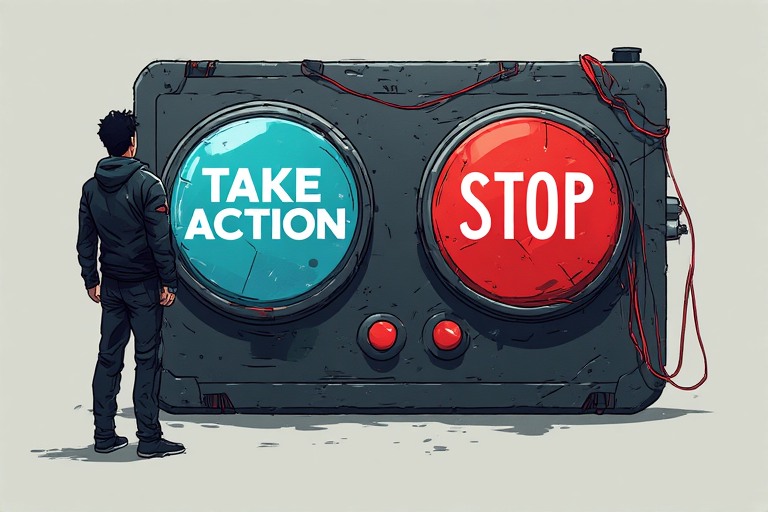
What Authority Anxiety Does to Initiative Over Time
This is the part that has the most practical cost.
When independent action is consistently associated with punishment in your nervous system, you stop taking it. Not in a dramatic way — gradually, quietly. You wait to be asked instead of volunteering. You hesitate before making decisions that are clearly yours to make. You check in more than you need to, seeking a kind of pre-approval that makes the action feel safer.
In a workplace context, this can look like low confidence or lack of drive. It isn’t. It’s a nervous system that learned a very specific rule — act without permission and something bad follows — and is applying that rule consistently, even when the context has completely changed.
Fear-based leadership — the kind of management that uses unpredictability, criticism, and implied threat to keep people compliant — reactivates this pattern in adults who experienced it in childhood. Even managers who aren’t trying to do this can trigger it unintentionally, simply by occupying the authority position.
The result is someone who is often more capable than their behavior suggests, working under a set of invisible constraints that other people around them don’t have. Taking the initiative that feels dangerous to you is something your colleagues might do without a second thought. That asymmetry is real. And it’s not a reflection of your actual competence or potential.
What Starts to Change
Authority anxiety built through narcissistic parenting trauma doesn’t resolve through willpower or positive thinking. The pattern lives in the body — in the automatic threat response, in the physical tightening when certain words land. That’s where the change eventually has to reach.
What tends to shift first is recognition. The ability to notice, in the moment, what’s actually happening — this is the old conditioning activating, not an accurate read of this situation. That gap between the feeling and the automatic response is small at first. But it grows.
Repeated safe experiences with authority figures — interactions that don’t follow the old script, managers who respond to initiative with appreciation rather than punishment — slowly begin to update the template. Not quickly. Not in a linear way. But the nervous system is not a fixed structure. It learns. It just needs enough new evidence, repeated under enough different conditions, before it starts to trust it.
The four words that used to feel like a verdict — “we need to talk” — can, over time, become just four words. That shift is possible. It’s just not fast. And understanding that the fear is conditioned, not accurate, is where it begins.
If authority anxiety is affecting your work, your relationships, or your ability to act on your own initiative, these are well-documented effects of narcissistic parenting trauma and childhood conditioning. A trauma-informed therapist can help identify the specific patterns at play and support the nervous system in updating them. EMDR is particularly effective for emotional flashbacks and the deep-body responses that drive authority anxiety — working at the level where the pattern is actually stored, not just the conscious understanding of it.