Why Survivors of Narcissistic Families Feel Low Status in Social Situations: The Scapegoat Conditioning Explained
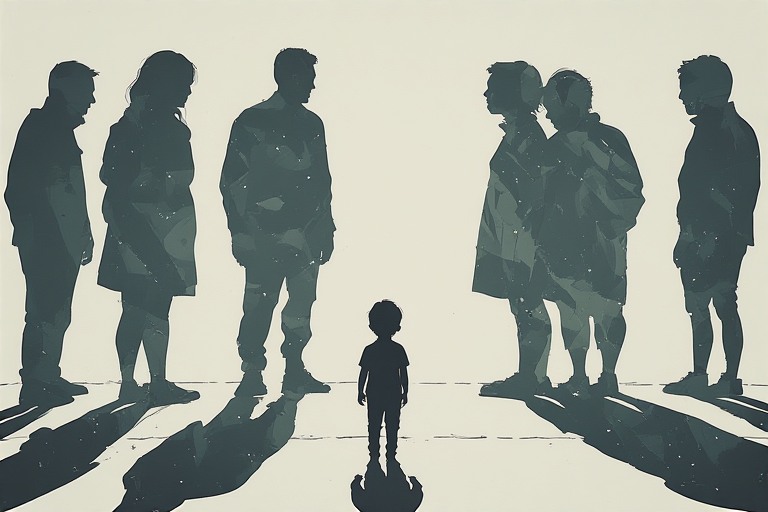
There’s a feeling that many survivors of controlling or narcissistic family systems carry into adulthood that’s difficult to describe without sounding like you’re catastrophizing.
It shows up in social settings — at a party, in a meeting, at a club, anywhere that other people seem comfortable and at ease. And it produces a quiet but persistent internal verdict: everyone else belongs here. I am worse. Slower. Less than. As if other people were issued a manual for existing in the world that somehow never arrived for you.
The feeling isn’t always that dramatic. Sometimes it’s just a low hum — a background sense of being slightly out of place, slightly below the natural level of the room, slightly deficient in some quality you can’t quite name. But it’s there, in social situations, and it’s particularly sharp in situations that involve any kind of evaluation: attractiveness, confidence, competence, social ease.
For years this feeling tends to get interpreted as a personal failing. Maybe I’m just not confident. Maybe I need to work on myself. Maybe other people have something I lack.
But the question worth asking is: where did this feeling come from? Not as a rhetorical gesture toward self-compassion, but as a genuine psychological inquiry. Because the answer, for most people carrying this feeling, points not to a personal deficiency but to a specific relational history.
Table of Contents
- Status is Assigned Before it’s Felt
- When the Family Position Becomes the Body’s Position
- What Repeated Defeat Does to a Developing Child
- The Confusion of Being Needed But Not Valued
- Why Other People Seem to Have Something You Don’t
- The Feeling Is Information, Not Verdict
- What Was Never Said But Should Have Been
Status Is Assigned Before It’s Felt
Every family has a social structure. Most families don’t announce it explicitly — there’s no meeting where roles are assigned and hierarchy is formalized. But the structure is there, operating through the texture of daily interactions, and children read it with extraordinary accuracy.
Who is deferred to in arguments. Whose needs generate immediate response and whose are treated as secondary. Who gets corrected more often, criticized more readily, overridden more casually. Whose presence seems to add something to the room and whose presence seems to require accommodation or management.
In healthy families, children experience fluctuating positions within this structure as they grow — more autonomy over time, more respect, more acknowledgment of their developing competence. The general direction is toward greater standing, not lesser.
In families organized around a rigid hierarchy — particularly those centered on a dominating parent who requires others to remain subordinate — certain children are assigned a fixed low position and kept there. Not cruelly, in most cases. Not even consciously. But systematically, through the accumulated weight of everyday interactions that consistently communicate: your place is below. You should not challenge. You are not the authority on your own experience.
The child doesn’t experience this as hierarchy assignment. They experience it as simply how things are. And the nervous system, which is building its model of the world from exactly these repeated experiences, encodes it as a fact about reality: I am lower status. That is my position.

When the Family Position Becomes the Body’s Position
This is the part that makes the pattern so persistent and so confusing in adulthood: the low-status position doesn’t stay in the family. It becomes embodied. It becomes how the nervous system orients in any social situation that has a hierarchy — which is most of them.
The mechanism is automatic and operates below conscious awareness. When you enter a room, when you meet a confident person, when you find yourself in any context where evaluation is possible, the nervous system runs its threat-detection scan and arrives almost instantly at a familiar conclusion: where do I rank here? And the answer it defaults to — because it’s the answer that was reinforced thousands of times throughout development — is: lower.
This is why the feeling seems disproportionate and disconnected from actual circumstances. The club is full of ordinary people. No one is evaluating you. There’s no objective reason to feel deficient. But the nervous system isn’t responding to the objective situation — it’s responding to the pattern it learned. And the pattern says: in social situations involving other people, your position is lower.
This is also why fixing it through willpower or positive thinking rarely works. The feeling doesn’t live in the cognitive layer where affirmations and self-talk operate. It lives much deeper — in the body’s automatic, pre-conscious assessment of its own position in the room. Changing it requires something that reaches that depth.
EMDR therapy is a bottom up type of therapy. It focuses on your nervous system, and actually processing the trauma inside your body. The good news is that you can do this with a EMDR therapist and through self guided EMDR modules >>
What Repeated Defeat Does to a Developing Child
One of the most formative experiences for a child’s sense of their own status is what happens when they assert themselves — when they push back, disagree, try to hold ground.
In healthy environments, children experience pushback as a normal part of navigating relationships. Sometimes they win the argument, sometimes they don’t. Sometimes adults override them with genuine authority, sometimes they acknowledge the child’s point. The overall message is: asserting yourself is a normal human activity with variable outcomes.
In households organized around a dominating parent who needs to win, the child’s experience of assertion is consistently different. Every time they push back, they lose. Not in an educational way that teaches them how to argue better or how to accept fair defeat. They lose through overwhelming force — intimidation, humiliation, escalation, or the withholding of approval. The parent doesn’t just win the argument; they demonstrate that the child’s resistance itself was the problem.
The nervous system draws the obvious conclusion: assertion leads to being crushed. The safest available strategy is to make yourself smaller before the crushing becomes necessary. Stop competing. Stop challenging. Lower your position preemptively, because the alternative — trying to hold ground and failing — is worse. So you were essentially conditioned to lose every conflict.
That strategic self-lowering, which was genuinely adaptive inside the family system, becomes habitual. It generalizes. And in social situations in adulthood, what was once a tactical response to a specific threat becomes the default orientation: I am lower, so I will behave as though I am lower, which will be confirmed in how I’m treated, which will confirm that I was right.

The Confusion of Being Needed But Not Valued
There’s a specific contradiction that children in these family positions often experience that adds another layer to the low-status feeling.
On one hand, they are heavily relied upon. Their emotional labor is required. Their compliance is essential to the family’s functioning. They are present, attentive, accommodating — and the family system genuinely depends on all of this. AKA… they use the scapegoat as the emotional rubbish bin.
On the other hand, none of this generates the kind of recognition that would signal genuine value. Their needs are secondary. Their achievements are unremarked or minimized. Their distress is an inconvenience. Their inner life is, effectively, not of interest.
So the child receives two messages simultaneously: you are necessary, and you do not matter. You are useful, and you are not worth prioritizing. You exist to serve the system, and the system does not exist to serve you.
This contradiction is deeply disorienting, because being necessary should feel like mattering. But the nervous system registers the difference between being used and being valued — even when the mind doesn’t yet have language for it. What gets encoded is something like: I am here for others. Others are not here for me. My role is service, not significance.
That encoded message becomes part of the low-status self-concept, operating in the background of social situations as a quiet certainty: other people’s lives and needs and presences are primary. Mine are secondary. I am on the periphery.
Why Other People Seem to Have Something You Don’t
There’s a specific version of the low-status feeling that’s worth addressing directly: the persistent sense that other people have a quality, an ease, a natural confidence that you simply weren’t issued.
People who move through the world with social confidence, who don’t seem to collapse into self-doubt in evaluative situations, who appear comfortable taking up space — they seem to have something innate that you somehow missed.
But they don’t have an innate quality you lack. What they have, almost always, is a nervous system that was not taught to associate social situations with the threat of being crushed back into a lower position. Their default orientation isn’t lower, so they don’t experience the automatic lowering that feels, from the inside, like a personal deficiency. It’s family scapegoat conditioning coming online.
The difference is not character or courage or some quality distributed unequally at birth. It is nervous system history. Their system learned that taking up space is generally safe. Yours learned that it is generally dangerous. Both systems are operating exactly as trained.
This is not a comforting distinction in the sense of making the feeling go away. But it is a clarifying one. The question stops being: what is wrong with me? And starts being: what did my system learn, and what does it need in order to learn something different?
The Feeling Is Information, Not Verdict
One of the most important shifts in working with this pattern is learning to relate to the low-status feeling differently when it arises.
The feeling, when it comes, presents itself as a verdict. A quick, authoritative assessment of where you stand, delivered with the certainty of something simply observed. But it isn’t a verdict. It’s information about the state of your nervous system — specifically, about what your nervous system was taught to expect.
That distinction matters because verdicts tend to be accepted. Information can be evaluated.
When the feeling arises in a social situation — the sense of being the odd one out, the slow one, the deficient one — the useful question isn’t: is this true? It’s: ah, my system is running the old pattern. What’s happening around me right now that activated it?
This doesn’t make the feeling disappear. But it creates a small gap between the feeling and identification with it. You are not the low-status person in the room. You are the person whose nervous system is currently producing a low-status signal based on old learned data.
That gap is where change begins. It’s small at first. The feeling is still there, still uncomfortable, still pulls at attention. But over time, as the nervous system accumulates evidence that the old rule is no longer accurate — that asserting yourself doesn’t result in being crushed, that taking up space doesn’t produce punishment, that your presence is not inherently peripheral — the signal gradually loses some of its certainty.
It doesn’t vanish overnight. But it softens. And it stops being the whole story.
What Was Never Said But Should Have Been
There’s a simple thing that should have happened and didn’t.
Someone — a parent, ideally, but any consistent adult would have done — should have communicated, clearly and repeatedly, through action as much as words: you matter. Your needs deserve attention. Your feelings are real and worth attending to. You are allowed to take up space. You don’t have to earn the right to be here.
That communication, delivered consistently across childhood, becomes the foundation of a stable sense of one’s own status in the world. Not arrogance. Not dominance. Just the basic, bodily certainty that you belong, that your presence is legitimate, that you are not inherently at the bottom.
For children who grew up in systems where that communication was absent or actively contradicted, rebuilding that foundation is the work. It happens slowly, through relationships where it is finally delivered — sometimes in therapy, sometimes in close friendships, sometimes through the patient accumulation of experiences in which you exist fully and the world does not punish you for it.
The low-status feeling is not a fact about who you are. It is a record of what was withheld. And what was withheld can, gradually, be received — even now, even late, even after a long time of believing the feeling was simply true.
The internalized low-status feeling described here is a common feature of complex trauma from hierarchical and narcissistic family systems. Somatic and trauma-informed therapy approaches work directly with the embodied dimensions of this pattern, addressing it at the level where it actually lives rather than purely through insight.